Monday, 7 May 2018

Monday May 7

Yesterday was spent in the garden, during which time a Holly Blue flew in and started laying eggs

Holly Blue
I kept having to rescue (chuck out) a mining bee which I believe to be Grey-patched Mining Bee, that was continually entering the kitchen.

Probably Grey-patched Mining Bee
Last night I set up the moth trap, and this morning spent plenty of time emptying it of the 17 moths I caught. Some were easy to identify:

Streamer
Chocolate-tip
The rest I have emailed photos of to John S, and will await his input before continuing with this post.

John has come up with the goods; supplying names for all but one of the ones I sent him. The missing moth escaped while I was extracting them and ended up high on the wall of the house. The resulting photo was shocking, although John still suggested a family of micro-moths, Acleris, it could be from.

Apart from one I hadn't a clue about, I was pleased he concurred with all my tentative identifications. The one that defeated me was Least Black Arches Nola confusalis. An appropriate latin name.

Least Black Arches
The full list was: One Streamer, one Chocolate-tip, six Pugs all of which were thought to be Brindled Pug (John is now checking those), one Early Grey, two Common Quakers, one possible acleris sp, one Light Brown Apple Moth, one Bee Moth,

Bee Moth
one Shuttle-shaped Dart,

Shuttle-shaped Dart
one Spruce Carpet,

Spruce Carpet
and one Least Black Arches. I also saw a millipede sp (it seems ages since I saw one of those). I will not be attempting to identify it.

Millipede sp
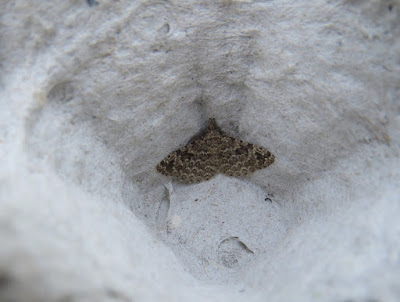
Finally, I have painted my moth trap white as my mentor says it will increase the numbers caught.

Friday, 4 May 2018

Friday May 4

The moth trap was in action last night and it duly pulled in eleven moths. Strangely, only three of the moths actually got into the trap, the rest were found on the utility room windows, the wall of the house and the fence.

I was delighted to find a really attractive moth, a Waved Umber, in the trap.

Waved Umber
The rest, however, comprised six pugs, a very dull noctuid, two Early Greys, and a Common Quaker.

Early Grey
I spent a long time trying to work out what species the Pugs were, and eventually emailed my findings off to John S. He has now replied with the news I got three right, and three wrong. Not very good in fact.

I clearly have no idea what Mottled Pugs look like, because I have again misidentified a Brindled Pug. Also, one I thought was an Oak Tree Pug was actually a Brindled Pug, and one I thought was a Brindled Pug was an Oak Tree Pug.

Nightmare.

An extremely drab moth was a Clouded Drab, as I had half suspected, and the final moth was a Common Quaker.

Brindled Pug
Smallish Brindled Pug

Oak Tree Pug
Clouded Drab
Tomorrow I'll be getting up at the crack of dawn to watch birds at Morton Bagot for an all day list. Back on familiar ground.

Thursday, 3 May 2018

Thursday May 3

Whisper it quietly, but I think Spring has finally arrived. I walked around Arrow Valley Lake in glorious sunshine.

Although the lake itself contained only the usual residents, I noticed two recently fledged Grey Herons below one of the nests, the main interest was provided by passerines in the surrounding bushes.

I counted a minimum of 10 Blackcaps, many vigorously defending recently acquired territories, and at least five Chiffchaffs making up the bulk of the warblers present. There were also some new arrivals. Three Reed Warblers sang from patches of reedbed. As always they were hard to see and at times it appeared the reedbed itself was responsible for the song. But with patience it was possible to get a view of sorts.

Reed Warbler
The highlight though was another LBJ (little brown job), this time singing from the hawthorn on the west side of the lake. And for once it showed well. A singing Garden Warbler.

Garden Warbler
Blackcap
Blackcap and Garden Warbler have rather similar songs. The former is the more mellifluent and shorter phrased, ending with a glorious crescendo, the latter slightly more guttural with less variation of pitch. The problem comes when a Blackcap chooses to chunter along under its breathe, leaving the would-be observer to finally give up on it. Or so I find!

It was not just migrants which entertained. Just about everything seemed to be nest-building or carrying food. The breeding season is well under way.

Mistle Thrush collecting worms
Coal Tit collecting moss
Greenfinch singing overhead

The warm weather was bringing out the insects too. Alderflies and St Mark's Flies were plentiful, and at least two Orange Tips fluttered by.

I have to say, it was a wrench to leave.

Friday, 27 April 2018

Friday April 27

Steady rain with a very light easterly. A visit to the docs for an MOT gave me the opportunity for a quick look at Arrow Valley Lake.

I only had time to walk to the dog-leg and back, but was pleased to see a single Common Tern standing on a buoy.

Common Tern
About 30 Swallows and six Sand Martins were flying back and forth low over the lake. I could also see two Common Sandpipers and a Pied Wagtail in front of the sailing club.

Thursday, 26 April 2018

Thursday April 26

It's been an unusual week. I have had time off from work but the wildlife watching has been interrupted by various things, some enjoyable, some desperately sad, and some down right bonkers.

So concentrating on the wildlife, Monday afternoon was split between watching bees in the garden and attending a talk by the excellent Mark Cocker at the Stratford Literary Festival. A female Hairy-footed Flower Bee showed well at lunchtime.

Hairy-footed Flower Bee
Tuesday was a wash-out both weatherwise and birdwise. A stroll around Arrow Valley Lake produced two drake Tufted Ducks, a pair of Jays, and about 20 hirundines, half of which were Sand Martins.

This morning dawned bright and sunny, but cold. I had run my moth trap overnight, but was not surprised to find I had only caught three moths; two Common Quakers and a Clouded Drab.

Clouded Drab
The one bonus of such a small catch was that I had time to revisit Arrow Valley Lake. The commonest singing bird there was Blackcap (nine), and I had the opportunity to photograph a Treecreeper.

Treecreeper
The Oystercatchers have returned from their brief absence, and unlike on Tuesday, I also saw a Common Sandpiper.

A potential nest site?
Three Little Egrets were present in the heronry, and the small hirundine flock was joined by a Common Swift, my first anywhere this year.

All wildlife watching then came to an end when I got a call to say that dad had gone AWOL again. It turned out he was guarding the door to his empty garage against some perceived threat from house-breakers. Oh dear.

On a brighter note, John S has emailed me to say that he had sent some of my moth photos for a second opinion by some even more experienced moth-ers (I would write mothers but it could cause confusion) and while almost all of the identifications were agreed, one of the pugs is actually an Oak Tree Pug, and not a Brindled Pug. However, another of the Brindled Pugs was indeed that species. I believe this is the reidentified beastie -

Oak Tree Pug
You live and learn.

Friday, 20 April 2018

Friday April 20

I was up early this morning, a man with a plan. The idea was to stroll over to Ipsley Alders to tick off a Grasshopper Warbler. The only problem was that there weren't any there.

In fact it was rather misty, and my first interesting creature was actually a mammal.

Roe Deer
Walking around the reserve I saw and heard six Blackcaps, two Willow Warblers, and four Chiffchaffs, but no new migrants.

The most significant bird was Pheasant, not just the adult male, but also a harem of two females.

Pheasant - male
Pheasant - female
Apart from that it was just the usual species singing away. I did have one more surprise in store though. What appeared to be a pensioners tea-party taking place in a scrubby area of the reserve was in fact my first encounter with the Redditch ringing group. I say encounter, the second I spotted them they got up from the trestle table they were sat around and headed purposefully towards a mist-net before disappearing into the woodland like an undiscovered New Guinea tribe.

I'd like to think it was nothing personal. I considered chasing after them and asking if they would mind if I photographed the Blue Tits and Robins as they released them, but that seemed a bit too sad, even for me, so I left them to it.

And that is how I didn't see the first Subalpine Warbler to be caught in the West Midlands.....just kidding...I hope.

By mid-morning I was back out, this time to Arrow Valley Lake. The mist was disappearing as I arrived and so I walked around in bright sunshine. Eight singing Blackcaps, seven singing Chiffchaffs, and four singing Willow Warblers were typical summer migrants.

I was then pleased to see a couple of Common Sandpipers in front of the sailing club and a single Lesser Whitethroat which paused briefly with two Chiffchaffs which were disputing a territory vociferously while a presumed female looked on, calling regularly. The Lesser Whitethroat flew on and gave a brief rattle to confirm its identity.

The Common Sandpipers
I counted three singing Reed Buntings around the lake before I left.

Reed Bunting

Thursday, 19 April 2018

Thursday April 19

With the weather warming up rapidly, I decided to dedicate the day to the garden and more particularly to the insects therein.

The moth trap was emptied very slowly from about 07.00am to about 09.00am. It contained numerous insects which were new to me, and some of my identifications are currently on the tentative side. However, stop press, I am now amending a couple of things because my moth guru, John Sirrett, has replied to my email and has corrected one of my identifications and suggested a solution to the one that had me stumped.

The first moth seen was actually resting on the door of the utility room. After much deliberation I decided it was a Small Quaker. I tried photographing it against the life-size illustration in Waring et al as well as on the door.

Small Quaker
Assuming I have got them right, I counted nine Small Quakers and 16 Common Quakers in and around the trap this morning.

Common Quaker
Small Quaker on the left and Common Quaker on the right
Another species of Quaker in the trap was much more distinctive; a Twin-spot Quaker.

Twin-spot Quaker
What I was really hoping for was something big and impressive. Two species fitted the bill, a Brindled Beauty and an Early Thorn.

Brindled Beauty
Early Thorn
In contrast, I rather dread looking at Pugs. I duly found four of them. One was quite easy, the V-Pug. The other three were much harder. Two were larger than the third. I eventually decided the bigger ones were Mottled Brindled Pug, and the smaller one a darker than normal Double-striped Pug.

Brindled Pug on the left and double-striped Pug on the right
V-Pug
Two easier ones next.

Hebrew Character
Twenty-plumed Moth
I saw four of the former and only one of the latter. Thankfully there weren't many micros (like the Twenty-plumed), but I did get one which I thought would be distinctive enough to identify.

Small March Moth

I was mistaken. I think its some kind of pyralid sp, but I haven't come up with anything yet. In fact it was a micro, but not a Pyralid sp. It was a Small March Moth Diurnea fagella. John somehow managed to identify it on the basis of a photograph attachment that wouldn't enlarge. Impressive.

A couple of caddis flies also caused confusion as I at first thought they were some kind of giant micro-moths before the penny dropped. I may even have discovered their specific names.

Stenophylax permistus
Brachycentrus subnubilus
The very first insect to exit the trap, somewhat to my relief, was a wasp sp. I spent much of the afternoon trying to identify and photograph bees.

Tawny Mining Bee
Red Mason Bee
When we got back from Castle we realised there was a bee in the downstairs loo. I caught it, and identified it as a Grey-patched Mining Bee.

Grey-patched Mining Bee

No birds of note unless you count a Lesser Whitethroat heard from Castle Nurseries where Lyn and I were buying plants.