Saturday, 8 July 2017

Saturday July 8

Yesterday morning I spotted a pug on the kitchen window. After potting it I decided it was a Double-striped Pug, a species I have recorded in the garden before.

Double-striped Pug
Last night, another Tortrix moth made it into the bathroom. Currently down to one pot I decided to photograph it in the poor light of the living room before releasing it and hoping for something bigger.

Fruit-tree Tortrix sp
Nothing turned up, and the photo leaves me torn between Dark Fruit-tree Tortrix and Barred Fruit-tree Tortrix.

However, tonight was a different story. It began well as I found a second perspex pot. This meant that as long as only two moths turned up I would be able to carry on catching and photographing the following morning.

Straight away I caught my two moths, a massive Large Yellow Underwing, and a fascinating micro which was clearly going to be a new one.

Large Yellow Underwing
The new one proved to be Ypsolopha scabrella, the first of this genus of moths I have seen, though evidently not rare.

Ypsolopha scabrella
Unfortunately it didn't stop there, as four more moths entered the bathroom. Two were species I had seen this year, Crambus pascuella, and a Double-striped Pug. The third was possibly the moth from last night. My only option was to photograph them in the unnatural light of the bathroom.

Probably Dark Fruit-tree Tortrix Pandemis heparana
Crambus pascuella
Double-striped Pug
The last one was probably a new species, but my photo attempt was awful. My only hope is that it is still in the bathroom and I catch it tomorrow night.

Tortricidae sp
All to play for then.

Thursday, 6 July 2017

Thursday July 6

The very warm weather is continuing. Not much moth activity in our bathroom, just one micro (other than yet another Brown House Moth) was caught. I am having trouble identifying it, and think it may be from the tortricidae group. Thanks to Michael for suggesting, tentatively, Holly Tortrix as the solution.

Holly Tortrix - Rhopobota naevana

Rather easier to identify was a Small Tortoiseshell on the Buddleia. It has taken a very long time to record this once common butterfly. How are the mighty fallen! Lyn spotted a large white butterfly while I was at work, and I noticed a brown one flying across the road as I drove into our road.

Small Tortoiseshell

Sunday, 2 July 2017

Sunday July 2

Easing myself back into the patch by sitting in the garden this afternoon. The buddleia has flowered in our absence, and attracted a Red Admiral today.

Red Admiral
Two new butterflies for the year were a Ringlet and a Meadow Brown. Meanwhile a Robin was collecting food on our patio, and clearly is feeding young nearby. It was very relaxed about our proximity, even stopping to sun itself for a while.


Much trickier was a bee, which I think was a Willughby's Leaf-cutter Bee. We have had them nesting in a bee-house in the garden in previous years, but not at the moment.

Willughby's Leafcutter Bee
This evening a familiar moth flew into the bathroom, the first Riband Wave of the year.

Riband Wave

Saturday, 1 July 2017

Cruising the Norwegian fjords

I have been away, as the title of this post suggests, scanning a lot of breath-taking scenery and eating a lot of food. This was Lyn and my first holiday abroad for many years, but I don't think it is relevant to this blog to go on about it at length.

Where the wildlife was concerned it has to be said that cruising on a Cunard liner is not ideal, while our on shore activity was limited to pottering around a few ports. In other words I didn't see many birds.

In Norway itself, it was interesting to find that Common Gull was by far the commonest gull species at all the ports, House Sparrows are abundant, and with minimum effort I also saw a couple of Tree Sparrows. At our furthest north location, Arctic Terns were nesting on the roofs. Another common gull was the intermedius race of Lesser Black-backed Gull.

Arctic Tern
The larger corvids were all Hooded Crows, while the Jackdaw I saw at Stavanger was presumably of the race monedula, known as Nordic Jackdaw. Not that you could tell. The Alba Wagtails were White Wagtail of course.

Hooded Crow
A very subtle Nordic Jackdaw
Lesser Black-backed Gull - race intermedius
The trip up across the North Sea produced only Gannets, Guillemots, and Fulmars. The return journey in calmer conditions allowed me to see far more of the above plus a Manx Shearwater, an Arctic Skua, and a pair of summer-plumaged Red-throated Divers. Sadly all were too distant to be worth a photograph.

A stunningly beautiful country though.

Friday, 23 June 2017

Friday June 23

I've been sitting on a secret since the beginning of June, although it sounds like only I was keeping it, since the news seems to have been widely known for some time.

Anyway, at least one pair of Little Egrets has been attempting to breed on the island in the middle of Arrow Valley Lake. I was waiting for an outcome before mentioning it on this blog. Sadly it appears that the breeding attempt has been unsuccessful, and today I saw no Little Egrets at all.

Scroll back to June 2. A single Little Egret was incubating eggs on a small nest in the heronry.


A week later, it was still present but spent most of its time standing on the nest, and only a short period incubating.


Another week past, and on my next visit the nest was unattended, although four adult Little Egrets were present on the island. One of these may have been standing on a different nest, one that was hard to see although it may have been an old Grey Heron's nest.

I might be wrong, but I think this was the first breeding attempt in Worcestershire.

Sadly today it looks as though the attempt has been abandoned. I was left to look at the usual cast of characters, with at least three Common Terns still present. I'm sure they would breed if the council was to supply and maintain a couple of rafts.
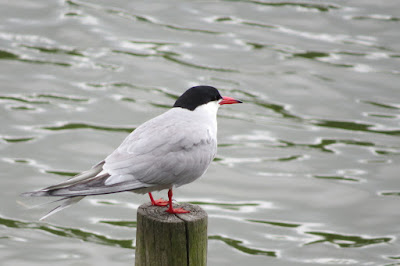
Common Tern
The weather was rather cloudy, but warm enough for butterflies to be on the wing. I just didn't see any. Instead, a Six-spot Burnet moth was feeding in the strip of wildflower meadow by the cafe.
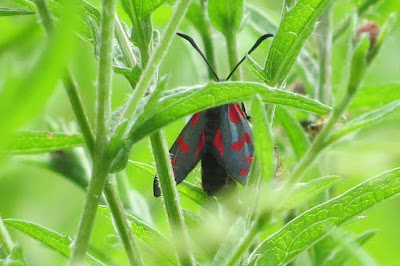
Six-spot Burnet
Unfortunately, when it finally settled I couldn't get a clear view of it. Just enough to count the spots though.


Thursday, 22 June 2017

Thursday June 22

The very hot weather of the last few days should have produced lots of moths, but its been disappointing. Last night I finally got a few micros. Two were Brown House Moth, but the other turned out to be an Ingrailed Grass Veneer Crambus pascuella.

Crambus pascuella
A common moth, but the first I have identified in the garden.

I've recently discovered the Biological Records Centre's website irecords@brc.ac.com. It is excellent for insects and provides helpful feedback when you submit photographs. I am working my way through a bit of a backlog.

However, I have noticed that there has been no feedback on my moth records. Reading through their forum it would appear that not all recorders favour this system, and moth records in particular seem to be a problem. It seems to depend on whether the particular Vice-County recorder for each species group wants to receive records in this way. Other recording methods are available.

As a former bird recorder, in the days before it all went high-tech, I certainly appreciate the amount of work recorders have to do, without pay. In the meantime I much appreciate the bee, butterfly, and indeed mollusc recorders who have vetted my records so far.

Sunday, 18 June 2017

Sunday June 18

A very warm night might have been expected leave me overwhelmed with moths in the bathroom. However, just one species entered. At least it was a new one for me.

Common Wave
It was a white moth, which meant I had to spend quite a time this morning sifting through several similar species of white Wave moths before concluding it was a Common Wave. The books suggest that this species is a little less common than the closely related Common White Wave, but the cross lines are wavier.

Later on today, during the evening, a vey small moth flew in through the kitchen window. It was potted and identified as Clepsis consimilana.

Clepsis consimilana
Another new species for me.