Tuesday, 23 August 2016

Tuesday 23 August

Since my last post the weather has warmed up again, and each evening has brought mini-beasts to examine and try to identify.

Beginning with Saturday evening I found a Hawthorn Shieldbug on the bedroom wall, and a boring little Brown House Moth in the bathroom. The following morning I photographed them with such mixed results that the moth, which quickly flew off, will not be shown.

Hawthorn Shieldbug
Shortly after the photo-shoot, I opened the front door to find a tiny little moth on it. This turned out to be the 25th record for Worcestershire of a micro-moth called Psychoides flicivora.

Psychoides flicivora
They apparently thrive on ferns, and its probably no coincidence that we have some right outside the front door. They are also an accidental introduction from Asia.

On Sunday evening a small macro-moth flew into the bathroom, and I was able to catch it and identify it as a Garden Carpet. Surprisingly, this was still a first for our house.

Garden Carpet
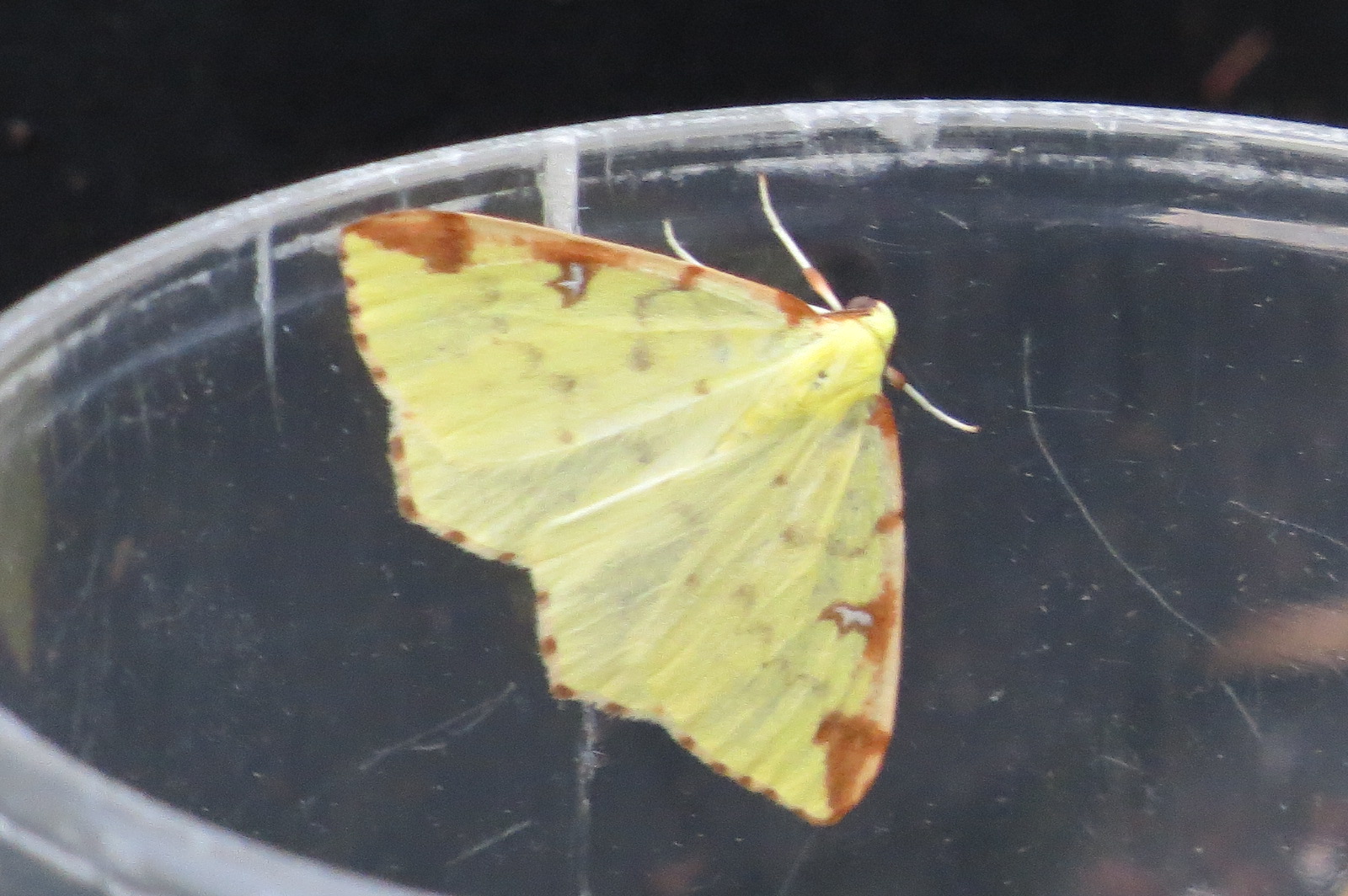
The following evening I caught a Cranefly which I think was Tipula oleracea, a Pug species, but released it when a common, but pretty, moth flew in. This was a Brimstone Moth, and a species I have recorded in several previous years.

Tipula oleracea

Brimstone moth
This morning, as I was supposed to be preparing to go to work, I noticed another moth on the kitchen window. I nipped outside and photographed it, deciding it was an Orange Swift.

Orange Swift
The reflection of the garden in the window makes for a very unusual shot. Finally, I arrived home to find that Lyn had entered into the spirit of it all as she directed me to a micro-moth in the utility room. This turned out to be Pyrausta aurata, although I may have released it a bit hastily as there are other Pyrausta species I should have considered. However, as I let it go I spotted a blue butterfly on the lavender.

Holly Blue
Not the first I have seen in the garden, but the first time I have photographed one here.

Thursday, 18 August 2016

Thursday August 18

Since my last post the weather has been very warm and sunny, which is good, and I have been at work, not so good. However, Lyn has come into her own, grabbing my camera and photographing a dragonfly yesterday.


As far as I can tell it is a Common Darter, which I think is a first for the garden.

Other than that, the best beastly action came from our bathroom on Monday night, with two largish moths making it across the threshold. Ironically, the one I instantly recognised is technically a micro-moth, the Mother of Pearl.

Mother of Pearl photographed on a dying herb pot the following morning
The second moth was a macro-moth, but of the kind I slightly dread, a boring brown one. After thumbing through my moth book and checking the internet I couldn't come up with a name for it. So I emailed the shot to Michael Southall of Butterfly Conservation, who promptly replied to tell me it was a Square-spot Rustic.

Square-spot Rustic
The diagnosis was slightly disappointing because I believe I have seen one here before, so I should have been able to work it out. They are very common, and in bird terms its a bit like finding out that the exciting bird in your garden is a Dunnock. To be fair to me, they are quite variable (unlike Dunnocks).

Last night was just as warm, but only one small, but familiar, micro-moth turned up. The Twenty-plumed moth.

Twenty-plumed moth
Finally, our buddleia has attracted three Painted Lady butterflies. A migrant species, and very pretty to boot.

Painted Lady

Sunday, 14 August 2016

Sunday August 14

Last night I attended a moth trapping evening organised by David Brown. It took place at Coughton Park, and was very enjoyable.

The main relevance to Winyates Beasts was that a fellow attendee was a chap I know only as Martin, but who was evidently a proper expert on micro-moths. I took the opportunity to show him my photos of moths taken in the bathroom (and at Morton Bagot) and was pleased to be informed that I had got most of them right.

The one error concerns the identity of the micro shown in the last post, which is in fact Bryotropha affinis, and not senectella as I had thought.

I have therefore made the necessary amendment.

The only noteworthy creature from the house today came as I was watching the Olympics. Across the road a sizeable Tit flock was giving tantalising glimpses of a phyllosc, which I eventually confirmed to my satisfaction as a Willow Warbler.

Finally, here are some Coughton Park moths, photographed in the light of the moth traps.

Ruby Tiger
Black Arches
Purple Bar
The full list of moths I managed to see was: Ruby Tiger, Lesser Broad-bordered Yellow Underwing, Large Yellow Underwing, Calcina quercana, Straw Dot, Black Arches, Mother of Pearl, Small Fanfooted Wave, Iron Prominent, Flame Shoulder, Willow Beauty, Lesser Swallow Prominent, Angle Shades, Maidens Blush, Purple Bar, Silver Y, Brimstone Moth, and a Hook Tip sp.

Thanks to all the mothers who told me what I was looking at.

Saturday, 13 August 2016

Saturday August 13

Regrettably I have very little to report since my last post.

The open bathroom window has ushered in very little, perhaps because of the coolish nights and strong winds of the last week. A further problem concerns the early starts I have to make to get to work. The issue is that I end up trying to photograph my "catch" in slightly gloomy post dawn light resulting in imperfectly precise identifications.

So last Sunday I potted a ridiculously small micro moth which turned out to be one of a genus called Bryotropha which comprises several near identical species. I came up with the name Bryotropha senectella, but this could easily be incorrect. The slightly blurry photograph didn't help much.

Bryotropha affinis
The following evening I trapped a slow moving beetle which is clearly some kind of weevil.

Possibly a Vine Weevil
It turned out that there are very many species of weevil to consider, so I am not sure which one I have caught.


Sunday, 7 August 2016

Sunday August 7

After a week of work and not much wildlife watching I only have a couple of interesting micro-moths and a welcome Peacock butterfly to report.

The micro-moths were both potted in our bathroom this morning. Interestingly it appears that their National status is described as local in both cases, so I am not sure what their status in Worcestershire is.

Blastobasis adustella

Recurvaria leucatella
By the time I saw the Peacock butterfly it was blowing a gale in the back garden. This is the first here this year, and only the second I have seen anywhere in what must be an absolutely terrible year for them.

Peacock

Sunday, 31 July 2016

Sunday July 31

Since my last post the weather has remained largely warm. This has  resulted in plenty of insect activity in the garden.

The huge lavender outside our kitchen window is at last proving a great draw for the local bees, and I have been driven to distraction trying to photograph and identify them. They mostly seem to be Buff-tailed Bumblebees, Bombus terrestris, and I have seen an obvious queen, and a lot of much less obvious workers. In fact it appears to be almost impossible to distinguish the workers of this species from White-tailed Bumblebees, Bombus lucorum, as they both show a largely white "tail", actually the abdomen.

Buff-tailed Bumblebee - queen
Buff-tailed Bumblebee - worker
Another common bumblebee which visits the lavender in good numbers is the Common Carder Bee Bombus pascuorum.

Common Carder Bee
This afternoon, however, I had a bumblebee tick. It's just a pity that its identification is rather tricky. What I do know is that it was a cuckoo bee, and what I think, because it was quite big, is that it is a parasite of the Buff-tailed Bumblebee, a species called Vestal Cuckoo Bee, Bombus vestalis. 

Vestal Cuckoo Bee
In contrast to the bees, it remains pretty hopeless for butterflies and moths. A handful of Gatekeepers, and Large Whites have visited, and I had a brief view of a Holly Blue. The only moth to get through the bathroom window was a micro, which I eventually concluded was a Dark Fruit-tree Tortrix Pandemis heparana.

Dark Fruit-tree Tortrix
Finally, yesterday morning I spotted a cranefly scooting along the kitchen floor. I potted it and took it outside for release and a mugshot. What a stonking beast it turned out to be. All Craneflies are not the same.

Nephrotoma flavipalpis
It doesn't seem to have an English name, and as I am not a latin scholar I can only propose that it be called Yellow-headed Cranefly. Not that anyone's listening.

Sunday, 24 July 2016

Sunday July 24

Following my last post the weather has remained warm, and I'm pleased to say that the insects have responded accordingly.

To begin with, the Buddleia and Lavender in the garden are starting to attract bumblebees and butterflies.

Buff-tailed Bumblebee - queen
Red-tailed Bumblebee - worker
The butterflies have included Red Admiral, Large White, and Gatekeeper. There remains a worrying complete absence of Peacocks though.

Gatekeeper in an unfamiliar pose
After dark the bathroom finally played host to some macro-moths last night. The Common Emerald and Fanfoot which I caught were both moths I had seen before, but were welcome nonetheless.

Common Emerald
Fanfoot
I also saw a Silver Y fluttering on the lavender after dark three nights ago, but it declined to appear in the bathroom.

Finally, a somewhat less wild beast.

Fred
We are currently giving my sister's tortoise its annual summer holiday. It mainly stays in the garden, but has learnt how to climb the back step if we are silly enough to leave the back door open...and we are definitely silly enough to do that.

Fred is over 50 years old (a family heirloom) and was discovered to be a she many years ago, but the name Fred has been retained. It's not house-trained, but has not disgraced itself yet this summer.